How Does a Car AC Compressor Work? A Complete Guide for Car Owners
If you've ever wondered what actually makes your car's AC blow cold air, the answer starts with one part — the AC compressor. Most people know it exists somewhere under the hood, but very few understand what it actually does and why it matters so much.
In this blog, we'll break down exactly how a car AC compressor works, what happens when it fails, and how to keep it running longer — all in simple, easy-to-understand language.
First, Let's Understand the Basics of a Car AC System
Before we talk about the compressor specifically, it helps to understand how the entire AC system works.
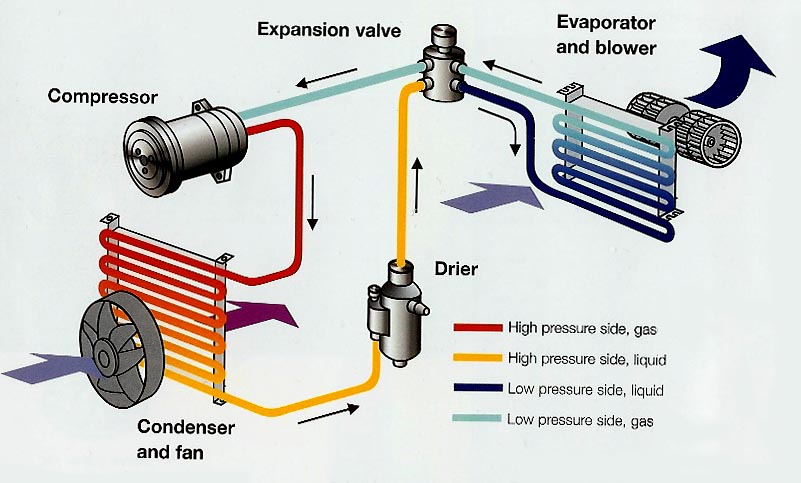
Your car's AC system is basically a closed loop that circulates a special gas called refrigerant (usually R134a in most Indian cars). This refrigerant travels through different components — absorbing heat from inside the cabin and releasing it outside — which is how you get cold air.
The main components in this loop are:
- AC Compressor — compresses and pushes the refrigerant
- Condenser — releases heat outside the car
- Receiver Drier — filters and removes moisture from refrigerant
- Expansion Valve — controls refrigerant flow and pressure
- Evaporator — absorbs heat from cabin air to produce cooling
The compressor is where this entire cycle starts. Without it, nothing moves, nothing cools.
So What Exactly Does the AC Compressor Do?
Think of the AC compressor like the heart of the AC system. Just like the heart pumps blood through your body, the compressor pumps refrigerant through the AC system.
Here's what it does in simple steps:
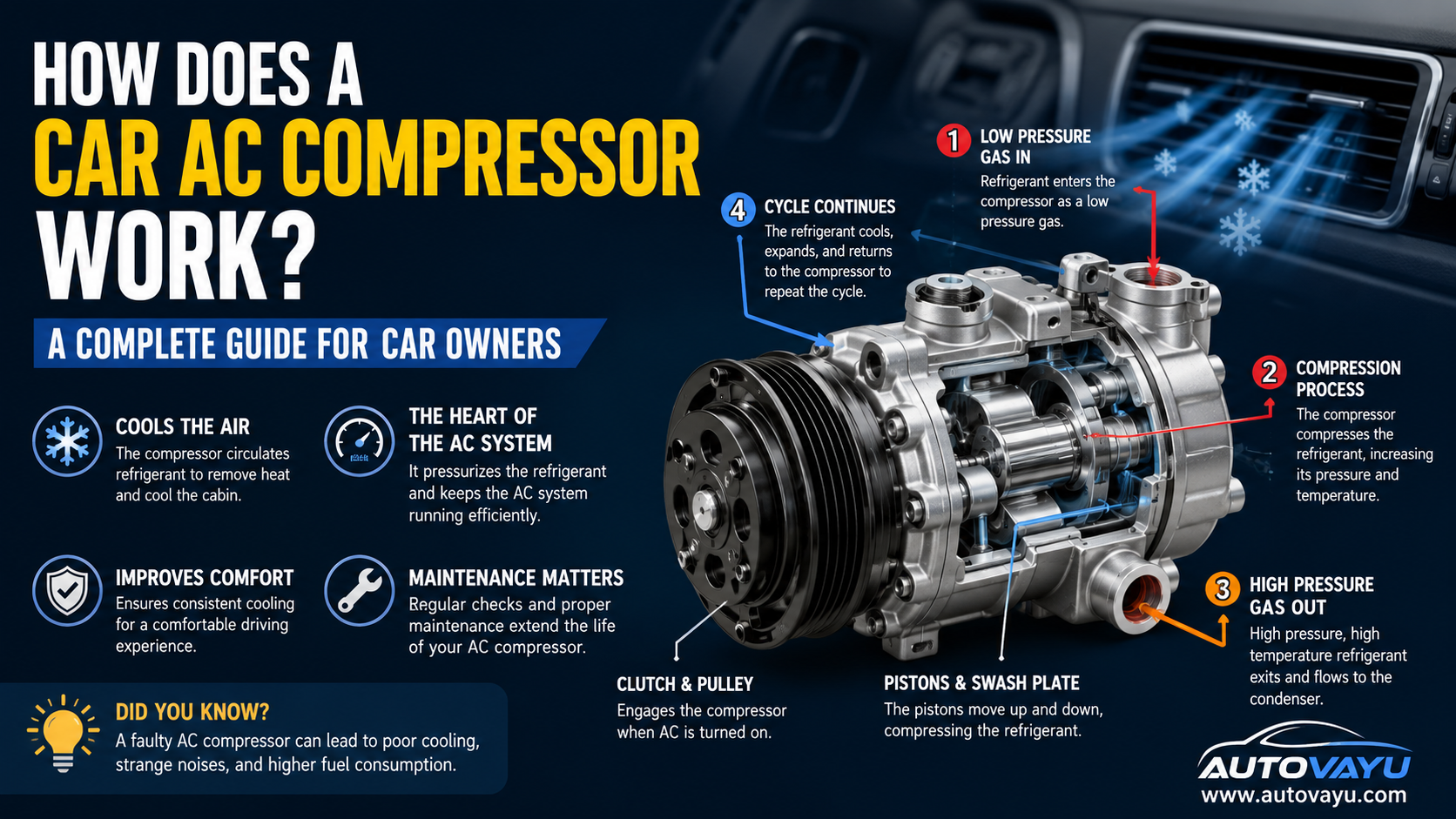
Step 1 — It receives low-pressure refrigerant gas coming back from the evaporator (the part that cools the cabin air). At this point, the refrigerant is in a low-pressure, low-temperature gas form.
Step 2 — It compresses the gas. The compressor uses pistons, scrolls, or vanes (depending on the type) to squeeze the refrigerant tightly. This compression raises both the pressure and the temperature of the gas significantly.
Step 3 — It sends high-pressure, hot gas to the condenser, which is mounted at the front of the car near the radiator. The condenser then cools this hot gas down by releasing the heat into the outside air, turning it back into a liquid.
Step 4 — The cycle continues. The refrigerant, now as a high-pressure liquid, travels through the expansion valve, drops in pressure, turns very cold, and enters the evaporator inside the cabin — where it absorbs heat from the cabin air and produces the cold air you feel from the vents.
Then it returns to the compressor again, and the whole process repeats — dozens of times every minute.
How Does the Compressor Get Its Power?
This is something most people don't think about. The AC compressor doesn't run on electricity as many might assume. It is driven by your car's engine through a serpentine belt (also called a drive belt or V-belt).
When you press the AC button inside the car, an electromagnetic clutch on the front of the compressor gets activated. This clutch engages the pulley with the compressor shaft, which puts the compressor into motion. When you turn the AC off, the clutch disengages and the compressor stops — even though the pulley keeps spinning freely.
This is why you might have noticed:
- A slight drop in engine power or pickup when you turn on the AC — the engine is now driving the compressor
- A small increase in fuel consumption when the AC is running — same reason
Types of Car AC Compressors
Not all compressors work the same way internally. There are a few different designs used in modern cars:
1. Piston Type (Reciprocating Compressor)
This is one of the older and more common designs. It uses pistons moving back and forth inside cylinders to compress the refrigerant — similar in concept to a small engine. These are reliable and easy to service, which is why they're still widely used.
2. Scroll Compressor
This design uses two spiral-shaped scrolls — one fixed and one rotating — to compress the refrigerant. It's smoother, quieter, and more efficient than piston-type compressors. You'll find scroll compressors in many newer cars, including several Hyundai and Kia models.
3. Rotary Vane Compressor
Uses rotating vanes inside a cylinder to compress refrigerant. These are compact and lightweight, often used in smaller cars where space under the hood is limited.
4. Variable Displacement Compressor
This is the most advanced type. Instead of running at full capacity all the time, a variable displacement compressor adjusts how much refrigerant it pumps based on how much cooling is actually needed. This saves fuel and reduces load on the engine. Many modern cars use this type for better efficiency.
The Role of the AC Clutch — An Important Part People Overlook
The AC clutch sits right on the front face of the compressor. It has three parts — the pulley, the electromagnetic coil, and the clutch plate.
When the AC is turned off, the pulley spins freely without driving the compressor. The moment you switch AC on, electricity flows through the electromagnetic coil, which creates a magnetic field and pulls the clutch plate onto the spinning pulley. The plate locks in, and the compressor starts running.
If the clutch fails, the compressor won't engage even if the compressor itself is perfectly fine. This is a common issue and is often confused with a full compressor failure. A good mechanic will check the clutch first before recommending a full compressor replacement.
What Happens When the Compressor Fails?
A failing compressor usually doesn't stop working all at once. It gives you warning signs before it completely breaks down. Here's what to watch for:
- Warm air from AC vents — The most obvious sign. If the AC is running but blowing warm or slightly cool air, the compressor may not be compressing refrigerant properly.
- Loud clicking or rattling noise when AC is on — Internal components like bearings or pistons may be worn out. This noise usually gets louder over time.
- AC turns on and off by itself — The system has a high-pressure switch that shuts the compressor off if pressure gets too high. If the compressor is struggling, this can happen frequently.
- Refrigerant leaking around the compressor — Oil stains or moisture near the compressor body indicate a seal failure.
- Visible damage or seizure — A completely seized compressor will not turn at all. Sometimes the belt connected to it breaks as a result.
How Long Does a Car AC Compressor Last?
In Indian conditions, where the AC is used almost year-round in most regions, a compressor typically lasts between 8 and 12 years. However, this depends on several factors:
- How often you use the AC — Heavy usage in hot climates like Delhi, Rajasthan, or UP puts more load on the compressor
- Regular maintenance — Keeping the refrigerant at the right level and using quality compressor oil makes a big difference
- Driving habits — Running the AC at maximum cooling all the time puts more strain on the compressor than using it at moderate settings
- Quality of the compressor — OEM or branded aftermarket compressors from manufacturers like Hanon, Doowon, or Subros generally last longer than cheaper local units
Tips to Keep Your Car AC Compressor Healthy
A little maintenance goes a long way. Here's how you can extend the life of your compressor:
Run the AC for at least 10 minutes once a week, even in winter. This keeps the compressor seals lubricated and prevents them from drying out and cracking. Many people skip the AC completely in winter and then wonder why it doesn't work when summer arrives.
Don't turn the AC on at maximum cooling straight away. Give the engine a minute to warm up and the refrigerant system to stabilize before switching to the coldest setting.
Get the refrigerant level checked every year. Low refrigerant forces the compressor to work harder than it should. A simple top-up can add years to the compressor's life.
Replace the cabin filter and AC filter regularly. A blocked filter restricts airflow and puts extra load on the entire AC system, including the compressor.
Listen to your car. Any unusual sound when you turn the AC on — clicking, rattling, or grinding — is worth getting checked immediately. Catching a problem early almost always costs less than letting it develop into a full failure.
Use quality compressor oil. If you've had any AC work done, make sure the workshop used the correct type and quantity of compressor oil for your car model. Wrong oil or insufficient oil is one of the leading causes of early compressor failure.
When Should You Replace the Compressor vs. Repair It?
This is a practical question that every car owner faces. Here's a rough guide:
Go for repair if — the issue is only with the clutch, the pressure switch, or a minor refrigerant leak. These are relatively affordable fixes that don't require replacing the whole compressor.
Go for replacement if — the compressor is making loud internal noises, has seized, or has metal shavings inside it (visible when the old refrigerant oil is drained). A compressor with internal damage will contaminate the entire AC system if left unaddressed, leading to much bigger repair costs.
At Auto Vayu, we offer compressors for a wide range of popular Indian car models — from Hyundai, Ford, Honda, and Chevrolet — at genuine prices. You can find both OEM-grade and quality aftermarket options depending on your budget.
.jpg)