The Five Major Parts of Your Car's A/C System
Summer in India hits hard. Whether you're stuck in Delhi traffic or cruising on the highway, a working car air conditioner is not a luxury — it's a necessity. But most car owners don't really know how their A/C system works, and that's usually when problems get expensive.
Understanding the key components of your car's A/C system helps you spot trouble early, talk to your mechanic confidently, and make smarter decisions when it's time to replace a part. So let's break it down — no jargon, no fluff.
Here are the five major parts of your car's A/C system and what each one actually does.
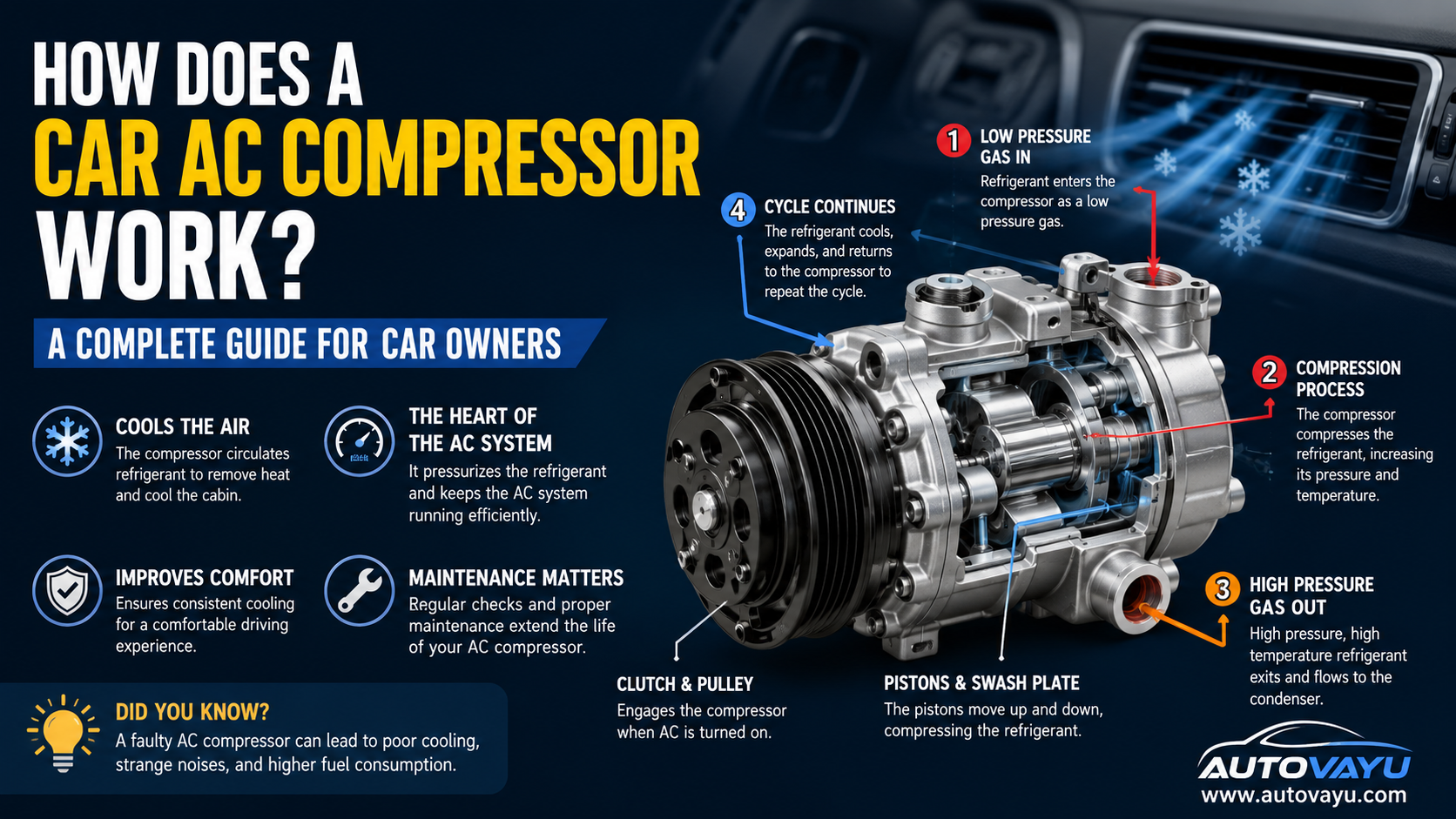
1. The AC Compressor — The Heart of the System
If your car's A/C had a heart, it would be the compressor. This is the most important — and most talked about — component of the entire system.
The compressor is a pump driven by your engine through a belt. Its job is to compress the refrigerant gas and push it through the rest of the A/C system under high pressure. When the compressor kicks on, you'll usually notice a slight drop in engine RPM — that's the load it puts on the engine.
Signs your compressor might be failing:
- A/C blows warm air even on the highest setting
- Loud clicking or grinding noise when A/C is turned on
- A/C works only sometimes, then stops
A faulty compressor can make the entire system stop working. Since it's also one of the pricier parts to replace, catching the warning signs early saves a lot of money.
Pro Tip: Never run your A/C on a low refrigerant charge for too long. It starves the compressor of lubrication and causes premature wear.
2. The Condenser — Where the Heat Goes Out
Once the compressor pressurizes the refrigerant, it travels to the condenser. Think of the condenser as a smaller version of your car's radiator — it sits at the front of the vehicle, right behind the grille.
The condenser's job is to release heat from the refrigerant into the outside air. As the hot, high-pressure refrigerant gas passes through the condenser's coils, it loses heat and turns into a liquid. The condenser fan helps push air across the coils to speed up this process.
Common condenser problems:
- Bent or damaged fins from road debris (very common in Indian road conditions)
- Leaks from small cracks or holes
- A clogged condenser that can't dissipate heat properly
If your condenser is dirty or damaged, the refrigerant can't cool down properly — and your A/C will struggle to blow cold air no matter how hard the rest of the system works.
3. The Receiver Drier / Accumulator — The Filter Nobody Talks About
This one is often overlooked, but it plays a surprisingly important role.
The receiver drier (used in systems with expansion valves) or accumulator (used in systems with orifice tubes) acts as a filter and moisture trap for the refrigerant.
Here's why that matters: moisture is the enemy of an A/C system. Even tiny amounts of water inside the refrigerant lines can cause corrosion, freeze up the expansion valve, and contaminate the compressor oil. The receiver drier absorbs that moisture using a desiccant material inside it and also filters out contaminants before the refrigerant reaches the expansion valve.
When should you replace the receiver drier?
- Any time the A/C system is opened up for major repairs
- If the system was exposed to air (open lines)
- Every 2–3 years as part of routine A/C maintenance
It's a relatively inexpensive part, but skipping its replacement during a repair job is one of the most common mistakes that leads to repeat A/C failures.
4. The Expansion Valve — The Pressure Controller
The refrigerant has been compressed, cooled, and filtered. Now it needs to be converted back into a gas so it can absorb heat from inside your car's cabin. That's where the expansion valve comes in.
The expansion valve controls exactly how much liquid refrigerant flows into the evaporator. It does this by creating a pressure drop — when the high-pressure liquid refrigerant passes through the small orifice of the valve, it rapidly expands and cools down. This is the same principle behind why a spray deodorant can feels cold when you use it.
Signs of a failing expansion valve:
- A/C fluctuates between cold and warm
- Frost forming on the A/C vents or evaporator
- No cold air at all despite the compressor working
A faulty expansion valve can flood the evaporator with too much refrigerant or starve it entirely — both of which kill your A/C's cooling performance.
5. The Evaporator — Where Cool Air Is Actually Made
Last but certainly not least, the evaporator is where the magic happens — it's where your cabin actually gets cooled.
The evaporator is located inside your car, usually behind the dashboard inside the HVAC box. It looks similar to a condenser but much smaller. The cold, low-pressure refrigerant flows through the evaporator's coils, and the blower motor pushes cabin air across those cold coils. As the air passes over the cold surface, heat is absorbed from the air — and that's what creates the cool breeze you feel from your vents.
The evaporator also dehumidifies the air as it cools — that's why you see water dripping from under your car when the A/C is running. That's condensation from the moisture pulled out of the cabin air, which is completely normal.
Common evaporator problems:
- Musty or foul smell from the vents (mold/bacteria buildup on the coils)
- Reduced airflow even when the blower is on high
- Refrigerant leaks (usually detected by an oily residue or musty smell)
Evaporator leaks are tricky to fix because the part is buried deep in the dashboard — which is why replacement can be labour-intensive. Keeping your cabin filter clean helps extend the life of your evaporator.
How These Five Parts Work Together
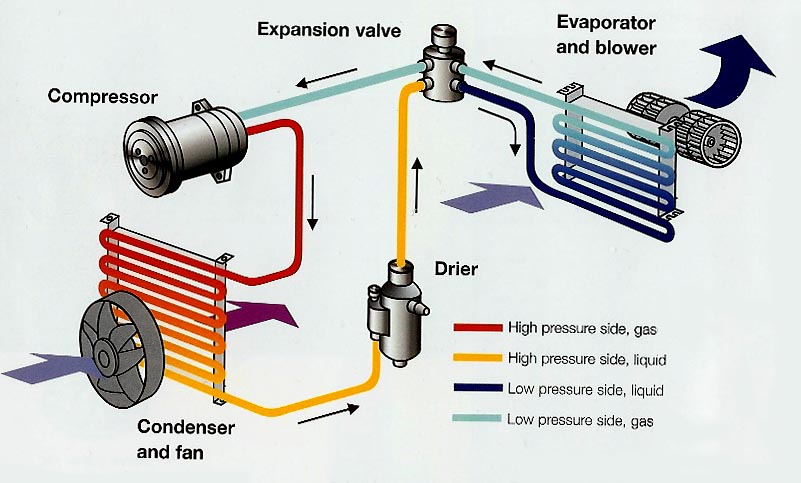
To put it simply, your car's A/C works in a continuous cycle:
- The compressor pressurizes the refrigerant gas.
- The condenser cools and liquefies it by releasing heat outside.
- The receiver drier removes moisture and filters contaminants.
- The expansion valve drops the pressure, making the refrigerant cold.
- The evaporator absorbs heat from the cabin air, delivering cool air through your vents.
When one part fails, the whole system suffers. That's why proper diagnosis matters — replacing just the compressor when the receiver drier is also contaminated, for example, will likely lead to compressor failure again in a short time.
When to Service Your Car's A/C System
Most manufacturers recommend an A/C check every 1–2 years, but in India's dusty and hot climate, annual checks are a smarter move. Watch for these signs that something needs attention:
- Weak or warm airflow from vents
- Unusual noises when A/C turns on
- Musty or unpleasant smell
- A/C takes longer than usual to cool the cabin
- Visible moisture or oily stains near A/C components
Get Quality Car AC Parts at Auto Vayu
At Auto Vayu, we stock genuine and aftermarket car AC spare parts for all major car brands — from Maruti Suzuki and Hyundai to Toyota, Honda, BMW, and beyond. Whether you need a replacement AC compressor, condenser, evaporator, expansion valve, or receiver drier, we have quality parts at competitive prices delivered right to your doorstep.
Browse our full catalog at autovayu.com or call us at +91-965-000-5290 to speak with our team.
.jpg)